






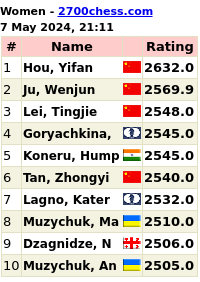
If there’s a human face on Rising China, it belongs not to some Politburo chief, not to an Internet tycoon, but to a quiet, mild-mannered teenage girl named Hou Yifan.
Ms. Hou (whose name is pronounced Ho Ee-fahn) is an astonishing phenomenon: at 16, she is the new women’s world chess champion, the youngest person, male or female, ever to win a world championship. And she reflects the way China — by investing heavily in education and human capital, particularly in young women — is increasingly having an outsize impact on every aspect of the world.
Napoleon is famously said to have declared, “When China wakes, it will shake the world.” That is becoming true even in spheres that China historically has had little connection with, like chess, basketball, rare earth minerals, cyber warfare, space exploration and nuclear research.
This is a process that Miss Hou exemplifies. Only about 1 percent of Chinese play chess, and China has never been a chess power. But since 1991, China has produced four women’s world chess champions, and Ms. Hou is the one with by far the most promise.
At this point, I have to put my sensitive male ego aside. You see, Ms. Hou gamely agreed to play me after I interviewed her. She had just flown into Beijing after winning the world championship, and she was exhausted — and she shredded me in 21 moves.
Most dispiriting, when I was teetering at the abyss near the end of the game, her coach nudged her and suggested mischievously that we should switch sides. Ms. Hou would inherit my impossible position — and the gleam in her coach’s eye suggested that she would still win.
I protested that I could survive being beaten on the chess board by a schoolgirl. But to be toyed with, like a mouse by a cat — that would be too much. Ms. Hou nodded compassionately and checkmated me a few moves later.
Hela artikeln
Schacksnack har en ny omröstning längst upp i högerspalten. Frågan gäller huvuvida Gideon Ståhlberg, Ulf Andersson eller Nils Grandelius är att betraktas som Sveriges genom tiderna starkaste schackspelare. Det finns ju lite olika måttstockar att beräkna detta genom till exempel ratingprestationer, hårt motstånd över tid eller hur vederbörande har bidraget till schackets utveckling. Beroende på perspektiv och hur insatt man är i denna komplexa fråga kan svaren skifta. Vad säger Schacksnacks läsare?
Sverigemästarklassen och övriga grupper arrangeras i Uppsala 27 juni - 6 juli. Tio spelare kämpar om Sverigemästartiteln och dessa är i ratingordning: GM Platon Galperin, IM Isak Storme, IM Jung Min Seo, GM Erik Blomqvist, IM Martin Lokander, GM Tiger Hillarp Persson., IM Milton Pantzar, IM Hampus Sörensen GM Jonny Hector och IM Axel Falkevall. SM-gruppen är i år stark och öppen så nästan vem helst kan ta hem segern men det skulle inte vara osannolikt om GM Jonny Hector avgår med segern. I SM-sammanhang brukar gedigen erfarenhet väga mycket tyngre än tillfälliga ratingtoppar. Mästar-Elit: IM Michael Wiedenkeller, IM Ludvig Carlsson, IM William Olsson, FM Eric Thörn, IM Tommy Andersson, IM Bengt Lindberg, FM Joar Östlund, FM Alexander Ström-Engdahl, Andreas Landgren och Harald Ljung. Mitt stalltips är att FM Joar Östlund som är en starkt utvecklande spelare kommer att avancera till Sverigemästarklassen.
 |
De stora internationella förbunden som utser arrangörer till OS och VM i fotboll har den senaste tiden figurerat i mindre smikrande sammanhang. Ledamöter med rösträtt har enligt bland annat den ansedda New York Times kunnat köpas. Tidningen har också i en artikel i sin chess blog – GAMBIT – offentliggjort misstankar om att samma förfarande använts inom schacket. Dessa riktas mot det Turkiska förbundet som enligt tidningen betalt röstberättigade inför valet av vem som skulle få arrangera Schack-OS 2012 och på detta sätt vunnit över Montenegro. Röstsiffrorna blev 95 mot 40. FIDE kommer att undersöka vad som hänt enligt ordförande Kirsan Ilyumzhinov.
Naturligtvis dementerar Turkiska förbundets ordförande – Ali Nihat Yazici – uppgiften.
Auditor’s Report Says Turkish Federation Paid for Votes to Win 2012 Chess Olympiad
By DYLAN LOEB MCCLAINA recent audit of the Turkish Chess Federation reported that the federation paid voters to help win an election for the right to host the Chess Olympiad in 2012.
Rumors of corruption have long plagued the chess world, where it is a commonly held assumption that elections of officials and decisions about where to locate tournaments are determined by bribery. But the disclosure by the Turkish federation may be the first time that anyone has admitted it so matter-of-factly.
The Olympiad is a national team competition held every two years, and one of the world’s premier chess events. Turkey won the right to host the event in Istanbul in 2012 after a vote among delegates of the World Chess Federation at the Olympiad in Dresden, Germany, in 2008. Turkey beat out Montenegro, the other finalist, by a vote of 95 to 40.
Holding an Olympiad does not create a financial windfall — indeed, the host may end up losing money as is common for the host country of the regular Olympics. But staging an Olympiad does confer prestige and winning the vote was considered an achievement for the Turkish Chess Federation.
Läs hela artikeln här.
Turkish Federation President Says Olympiad Bid Money Was Spent Legitimately
By DYLAN LOEB MCCLAINThe president of the Turkish Chess Federation denied Thursday that his group paid delegates to support Turkey’s successful bid to play host to the 2012 Chess Olympiad.
The president, Ali Nihat Yazici, said in a statement that the money spent on the bid paid for gifts, souvenirs, a booth to lobby delegates and transportation and accommodations for Turkey’s delegation at the 2008 Olympiad in Dresden, Germany, where the 2012 event was awarded. His statement appeared on the Web site Chessdom.com.
Läs hela artikeln här

 Laddar ...
Senaste kommentarer