


Results from round 5:
Michael Adams, England (2745) – Viswanathan Anand, India (2792) 0-1
Anish Giri, Netherland (2776) – Vladimir Kramnik, Russia (2760) draw
Fabiano Caruana, Italy (2839) – Hikaru Nakamura, U.S.A. (2767) draw
A little bit surprisingly Anand in the last round managed to catch up the duo Giri and Kramnik who drew their individual game after a dramatic fight. Caruana and Nakamura was also an eventful game to watch which ended in a draw. Anand, Kramnik and Anand scored 7 fotboll points but Anand won with the Black pieces and Kramnik and Giri with the White so that decided the tournament. Here follows the decicive game of London Chess Classic 2014:
Adams,Michael (2745) – Anand,Viswanathan (2793) [C67]
6th London Classic 2014 London ENG (5.3), 14.12.2014
1.e4!? e5 2.Nf3 Nc6 3.Bb5 Putting pressure on the most important pawn in Black’s position.
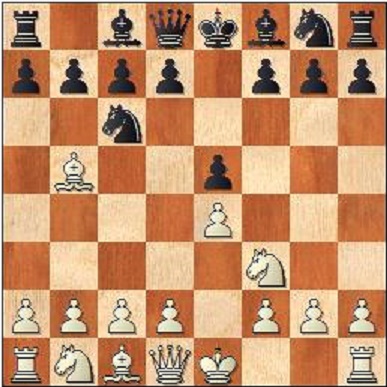
How should Black continue?
3…Nf6! Immediate counterattack on White’s most important pawn is a very clever device indeed. Another bonus except from the solidity of the move itself is that Black doesn’t need to bother with the slightly troublesome exchange variation. 3…a6!? was for a very long time without doubt regarded as Black’s strongest continuation. Now it seems that the played move has taken over as the most preferable choice, at least on the highest level. Steinitz’s move 3…d6 is very solid but regarded as too passive with modern eyes. After all, how to solve the problem with the Black bishop on f8? 4.0-0 4.d3 is the logical move if White fails to utilize his advantage in time more effectively in the main variation. 4…Nxe4 5.d4 Nd6 6.Bxc6 dxc6 7.dxe5 Nf5 8.Qxd8+ Kxd8 Black has the pair of bishops but a clearly worse pawn structure. However the e-pawn would have stayed better on e4 because Black has room for his pieces on the weakened squares f5 and d5. The main problem for Black is the connection between the rooks. If Black manages to solves this problem he can gradually take over the game because of his pair of bishops in a semi open position. 9.h3 Of course the knight must be driven away sooner or later with g2-g4 with the main purpose to activate the pawn majority on the kingside. First however development is more important. 9…Ke8 This is a very important decision. Now we know that Black will not place his king on b7. His plan is rather to play his queenside rook to d8 and at the same time Black’s king can be useful helping the blockading task of White’s pawns. 10.Nc3 h5 Weakens g5 seriously but stops g2-g4 for the time being. 11.Rd1 Be7 12.g3 Prevents the availability of a move such as h5-h4 crippling White’s pawns. 12…b6 13.a4! A clever move to provoke Black to play the same pawn move. 13…Bb7 13…a5 would give Black some problems after 14.Bf4 and Black must be careful of the possibility e5-e6 followed by Bf4xc7 och the pawn on b6 is hanging. 14.a5 c5 15.Nd5 Bd8 16.Bg5

How does Black proceed in this position?
16…Rf8! When Anand can handle his rooks, no one in the world can beat him. 17.c4 17.Bxd8 Bxd5! 18.Rxd5 Rxd8 is nothing special for White. 17…Bxd5 17…f6 18.exf6 gxf6 19.Bf4 Rf7 was maybe not to Anand’s liking, looking a bit passive, but it looks perfectly playable. 18.Rxd5 Bxg5 19.Nxg5 Ke7 Now we can make an evaluation of the position and conclude that Black has achieved an approximate equality. It seems far-fetched White has any winning chances because of his so called extra pawn on the kingside when Black’s king is even more active than White’s! 20.Kg2 Nd4 The knight cuts the connection between White rooks. Black’s knight is clearly more favourable compared with White’s on g5. 21.Rd1 Rad8 22.Nf3 c6 23.Rxd8 Why not 23.Rd6 Rxd6 24.exd6+ Kxd6 25.b4! with an easy draw? (The natural 25.Nxd4 cxd4 26.Rxd4+ Kc5 27.Rd7 bxa5 gives Black some chances because of the strong king.) 23…Rxd8 24.Ng5 b5! Forces White to release the prisoner on c6. 25.cxb5 cxb5 This is a moral victory for Black to get rid of the doubled pawn. White must be careful now. 26.Ne4 Nc6 27.Rxd8 Kxd8

What is White's best continuation in his quest for a draw?
28.e6? This is normally the key-move to dismantle the Berlin Defence but in this knight endgame situation it only make matters worse. White’s king and knight are too passive for such an operation. 28.Nxc5? Nxe5 29.f4 Nc6 30.Nb3 Kd7 31.Kf3 Ke6 32.Ke4 f5+ 33.Ke3 Kd5 and Black has some practical winning chances. Strangely Adams missed the the natural 28.f4 threatening both Nxc5 and Nd6 unless he played for a win. 28…fxe6 29.Nxc5 Ke7 30.Nb3 Kd6 31.Kf3 Kd5 32.Kf4 Kc4 33.Nc1 Nxa5 34.Kg5 Nb3 35.Ne2 b4 36.Kxh5 a5 0-1 Anand has done it again and won a tournament on the highest level. His competitors has a problem to solve: How to beat Anand in this variation? Even Magnus Carlsen was very lucky in the crucial world championship game to win from a worse position in this highly interesting middlegame without queens.
Final standings for all participants:
Viswanathan Anand, India (2792) 7 points
Vladimir Kramnik, Russia (2760) 7 points
Anish Giri, Netherland (2776) 7 points
Hikaru Nakamura, U.S.A. (2767) 6 points
Michael Adams, England (2745) 4 points
Fabiano Caruana, Italy (2839) 4 points
More information at Londonchessclassic.com
Här följer en intervju med segraren i London Chess Classic:

 Laddar ...
Senaste kommentarer